|
 The knee
disarticulation amputation (through – the –
knee – amputation) is executed if it is no
longer possible to maintain a short residual
section of the lower leg. Due to the
anatomical prerequisite,
functional and
cosmetic requirements, only modular
prostheses are used in the fitting of knee
disarticulations. In contrast to a transfemoral amputation, the residual limb
can be fully loaded after knee
disarticulation. Because the femoral condyles transfer body weight to the
prosthetic socket, no tuberosity seat is
required. The bulky shape of the condylar
residual limb provides for a rotationally
–stable connection to the prosthetic socket.
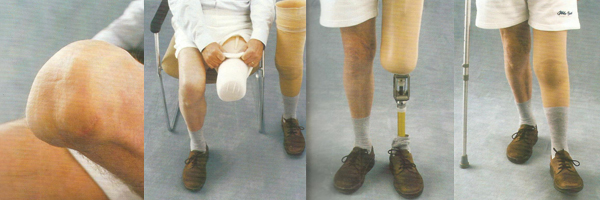
A soft socket of thermoplastic PE foam is
anatomically shaped inside, and by
compensating for the undercuts offers a
conical shape outside. This makes for easy
donning of the prosthesis during sitting. The knee
disarticulation amputation (through – the –
knee – amputation) is executed if it is no
longer possible to maintain a short residual
section of the lower leg. Due to the
anatomical prerequisite,
functional and
cosmetic requirements, only modular
prostheses are used in the fitting of knee
disarticulations. In contrast to a transfemoral amputation, the residual limb
can be fully loaded after knee
disarticulation. Because the femoral condyles transfer body weight to the
prosthetic socket, no tuberosity seat is
required. The bulky shape of the condylar
residual limb provides for a rotationally
–stable connection to the prosthetic socket.
A soft socket of thermoplastic PE foam is
anatomically shaped inside, and by
compensating for the undercuts offers a
conical shape outside. This makes for easy
donning of the prosthesis during sitting.
The musculature of residual limb remains
balanced because the adductors have not been
transected, while the long laver arm allows
for good control of the prosthesis. When
compared with the qualities of a
transfemoral amputation offers advantages to
both geriatric and athletic patients. Due to
the length of the residual limb, only
special knee joint construction can be
employed. The center of rotation of these
polycentric joints is located closed to the
anatomical axis of rotation.
|