|
Transfemoral
amputation – can be fitted with either
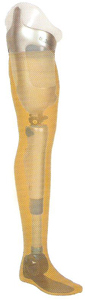
modular or exoskeletal designs. Modular
transfemoral prostheses are a good example
of the advances that have been achieved in
prosthetics. Important innovation have been
made concerning the fitting of prosthetic
sockets, socket materials and industrially
prefabricated prosthetic components.
Thermoplastic materials and lamination
resins have gradually replaced the use of
wood for the construction of transfemoral
sockets.
Design and fabrication of sockets can be
carried out with the aid of a computer.
Using special software, a positive model is
carved based on measurements of the
patient’s residual limb. This is used to
fabricate a thermoplastic test socket.
A number of new designs have been added to
the wide range of knee joints, prosthetic
feet and adapters. For geriatric patients in
particular, modules are employed to meet
their needs with a high degree of stability
and comfort [29].
 Stability during stance face and control of
the range of motion during swing phase are
further demands the various knee joints must
fulfill. Today, hydraulic stance face
control makes it possible for user to walk
down stairs step over – step, while
electronic regulators help user walk at
different speeds by adjusting resistance. Stability during stance face and control of
the range of motion during swing phase are
further demands the various knee joints must
fulfill. Today, hydraulic stance face
control makes it possible for user to walk
down stairs step over – step, while
electronic regulators help user walk at
different speeds by adjusting resistance.
Selection of the knee joint the prosthetic
foot depends on the patient profile,
residual limb function and therapy goals as
well as experience gained during the
fitting. The foam cover of the modular
prosthesis lends it a largely natural
appearance. It is custom
formed to the shape
of the contralateral leg.
Many young and athletic patients do away
with the cosmetic cover completely and
prefer an athletic appearance for the
prosthesis. By using specially – modified
prostheses they are they are able to achieve
amazing performances in disabled sports.
This fitted after surgical healing has
proven successful. The pre –shaped socket
made of thermoplastic material is shrunk
directly to the contours of the residual
limb by applying hot air.
This interim prosthesis is used until
manufacture of the definitive prosthesis. It
also supports the selection of the
appropriate definitive prosthesis.
In the case of very short transfemoral
residual limbs, the use of tilting sockets
construction is sometimes the only possible
solution. A hip joint with a lock is
attached distally to the prosthetic socket.
This may be disengaged for sitting.

|


